Related Posts:
Can Cryptocurrency Make You Rich?
The answer is Yes it can, infact some people became very rich through crypto read about them and how they started in this article.
But another fact is , many people also lost money.
This is the part every beginner must understand. Crypto can move very fast. A coin can go up 20% in a day and fall 30% the next day. Some coins disappear completely. Some exchanges fail. Some projects turn out to be scams.
So the better question is not:
Can crypto make me rich?
The better question is:
Can I learn crypto properly before putting my hard-earned money into it?
That mindset will save you and it will make you some serious profits.
let’s dive into the basics first.
Introduction: Why Everyone Is Talking About Cryptocurrency in 2026 ?
Imagine this.
You work hard every month. Salary comes. Rent, EMI, petrol, groceries, school fees, family expenses, mobile bills, and suddenly the month feels longer than your salary.
This is the reality for many people in India, especially young working men who want to do more for their family, build savings, and create an extra income source. That is why many people start looking at the stock market, mutual funds, side businesses, freelancing, and now, cryptocurrency.
But here is the truth: crypto is not magic money. It is not a shortcut to becoming rich overnight. It is a new type of digital asset that can create opportunity, but only for people who first understand it properly.
So, let us understand cryptocurrency in the simplest way possible.

What Is Cryptocurrency?
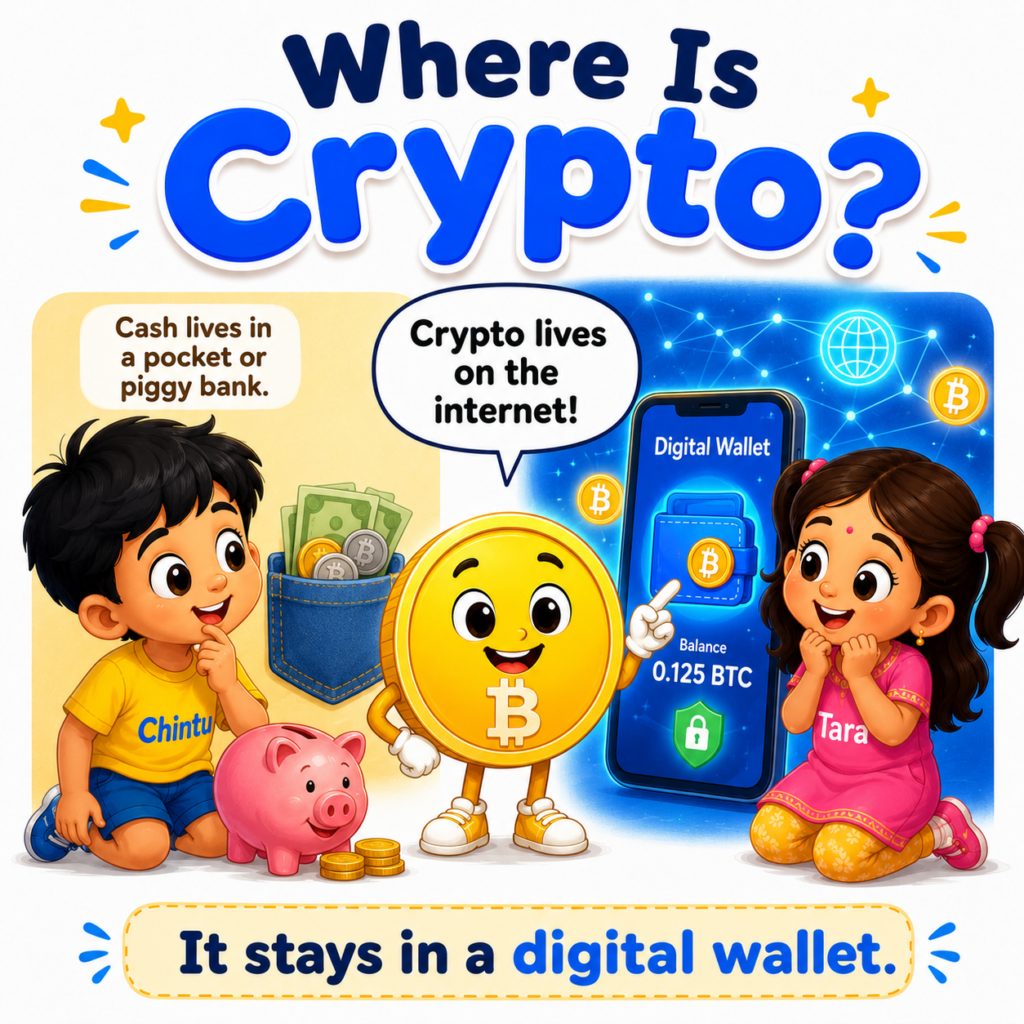
Cryptocurrency is digital money.
It does not exist as notes or coins like ₹100, ₹500, or ₹2,000 notes. It exists only on the internet.
For example, Bitcoin, Ethereum, and USDT are types of cryptocurrencies. You can buy them, sell them, send them to someone, or hold them as an investment.
In simple words:
Cryptocurrency is online money that uses technology to keep records safe and secure.
Coinbase explains that crypto transactions are secured by blockchain technology, which works like a constantly updated digital record of transactions. (Coinbase)
Simple Example: Think of Crypto Like Digital Gold
Many Indians understand gold very well.
Our parents and grandparents bought gold because they believed it had long-term value. Gold is limited, trusted by people, and can be bought or sold.
Bitcoin is often called “digital gold” because it is also limited. There will only ever be 21 million Bitcoin. But unlike gold, Bitcoin lives on the internet.
You cannot wear Bitcoin like a gold chain, but you can store it digitally and send it anywhere in the world.
This does not mean Bitcoin is always safe or always profitable. Its price can go up and down heavily. But the idea is simple: people give it value because they believe it is useful, limited, and independent from traditional banking systems.
Why Was Cryptocurrency Created?
Normal money is controlled by banks and governments.
For example, when you send money through UPI, your bank, NPCI, and other systems help process that payment. When you transfer money internationally, banks and payment companies are involved.
Cryptocurrency was created to allow people to transfer value directly using the internet, without always needing a middleman like a bank or credit card company. Coinbase describes blockchain as a public list of transactions that anyone can view and verify, making online value transfer possible without a traditional middleman. (Coinbase)
So crypto was built around one big idea:
Can money move on the internet without depending completely on banks?
That idea became Bitcoin.
How Does Cryptocurrency Work?
Let us keep this very simple.
Crypto works on a technology called blockchain.
Think of blockchain like a digital register.
In India, many small shopkeepers keep a notebook where they write:
Ravi paid ₹500
Amit bought goods worth ₹300
Suresh still has ₹200 pending
Blockchain is also like a register, but digital and much more advanced.
The difference is that this register is not kept by one person. It is shared across thousands of computers around the world. Every time someone sends crypto, that transaction is checked and added to the blockchain.
That is why changing old records becomes extremely difficult.
What Is Blockchain in Simple Words?
Blockchain is a chain of digital records.
Each group of transactions is called a block. When one block is filled with information, it is attached to the previous block. This creates a chain of blocks.
That is why it is called blockchain.
Simple example:
Block 1: Rahul sent Bitcoin to Amit
Block 2: Priya bought Ethereum
Block 3: Sameer sold some Bitcoin
All these records are connected one after another.
Once a transaction is added properly, it becomes very hard to secretly change it.

What Is Bitcoin?
Bitcoin is the first and most famous cryptocurrency.
It was created in 2009 by a person or group using the name Satoshi Nakamoto. Nobody knows for sure who Satoshi really is.
Bitcoin was created as a digital form of money that people could send directly to each other through the internet.
Example:
Suppose your brother is working in Dubai and wants to send value to you. Traditionally, he may use a bank or money transfer service. Crypto introduced a new idea where value can move from one digital wallet to another, across countries, without depending fully on traditional banking systems.
But remember, crypto transfer rules, taxes, and exchange regulations differ by country. Beginners should always use legal and trusted platforms.
What Is Ethereum?
Ethereum is another popular cryptocurrency network.
Bitcoin is mainly known as digital money. Ethereum is different because it allows developers to build apps on blockchain.
These apps can include smart contracts, NFTs, DeFi platforms, games, and other blockchain-based services.
Ethereum’s official history page says Vitalik Buterin conceived the idea of Ethereum in late 2013, and Ethereum later became one of the most important blockchain networks in the world. (ethereum.org)
Simple example:
Bitcoin is like digital gold.
Ethereum is like a digital city where people can build different apps and services.
What Are Stablecoins?
Stablecoins are cryptocurrencies designed to keep a stable value.
For example, USDT and USDC are commonly linked to the value of the US dollar.
So, if 1 USDT is designed to stay close to $1, its value is usually more stable than Bitcoin or Ethereum.
Many traders use stablecoins to move money between different crypto trades. However, stablecoins also have risks, so beginners should not assume they are completely risk-free.
Why Do People Buy Cryptocurrency?
People buy crypto for different reasons.
Some buy it as a long-term investment. Some trade it for short-term profit. Some use it to send money. Some believe blockchain is the future of finance and technology.
But for many normal people, the emotional reason is simple:
They want a better life.
They want extra income.
They want financial freedom.
They want to support their family.
They want to stop depending only on salary.
They want to feel that they are not missing a big opportunity.
This feeling is understandable. But emotion alone is dangerous in crypto.
Crypto rewards learning, patience, and discipline. It punishes greed, panic, and shortcuts.
Inspirational Crypto Stories
1. Changpeng Zhao, Also Known as CZ
Changpeng Zhao, popularly known as CZ, is the co-founder and former CEO of Binance, one of the world’s biggest crypto exchanges. His story is often shared in the crypto world because he came from a working background, built skills in software and trading systems, and later entered crypto. Reports say he worked on trading software earlier in his career and later sold his apartment to buy Bitcoin, a decision that became famous in the crypto community. (Wikipedia)
But his story also teaches another lesson: crypto success comes with responsibility. CZ later faced serious legal and compliance issues in the US and stepped down as Binance CEO. (Wikipedia)
So the real lesson is not “go all in.”
The real lesson is:
Learn deeply, take calculated risks, and respect rules.
2. Vitalik Buterin, the Young Mind Behind Ethereum
Vitalik Buterin learned about Bitcoin as a teenager. He started writing about Bitcoin and later created the idea for Ethereum. He was not just chasing quick profit. He was curious about technology and wanted to build something useful. Ethereum later became one of the biggest blockchain networks in the world. (Wikipedia)
His story teaches us something important:
The biggest winners in crypto are not always gamblers. Many are builders, learners, and patient thinkers.
3. Nischal Shetty, an Indian Crypto Entrepreneur
Nischal Shetty is known as the founder of WazirX, one of India’s well-known crypto exchanges. He is a software developer turned entrepreneur and became one of the recognizable Indian names in the crypto space. (CoinMarketCap)
His journey connects with Indian readers because it shows that crypto is not only a foreign concept. Indians have also built companies, communities, and products in this space.
Again, the lesson is not to blindly trade.
The lesson is:
Skill plus timing plus consistency can create opportunity.
Crypto Trading vs Crypto Investing
Beginners often confuse trading and investing.
Crypto Investing
Investing means buying a strong crypto asset and holding it for a long time.
Example:
You buy Bitcoin or Ethereum and hold it for years because you believe in its future.
This is usually less stressful than daily trading, but it still has risk.
Crypto Trading
Trading means buying and selling more frequently to make profit from price movement.
Example:
You buy Bitcoin at ₹50 lakh and try to sell it at ₹52 lakh.
Trading needs chart reading, risk management, stop-loss, emotional control, and market understanding.
Most beginners lose money because they start trading before learning.
A Simple Indian Example
Suppose Ravi earns ₹35,000 per month in Pune.
After rent, food, transport, family support, and bills, he saves only ₹4,000.
He sees a YouTube video saying, “This coin will become 100x.”
He puts ₹10,000 into that coin without research.
The coin falls 60%.
Now Ravi is angry, stressed, and confused.
This is how many beginners enter crypto.
Now imagine a smarter version of Ravi.
He first learns for 30 days.
He understands Bitcoin, Ethereum, blockchain, wallets, taxes, and risk.
He starts with a very small amount.
He never uses loan money.
He never invests emergency savings.
He avoids random Telegram tips.
He records every trade.
He accepts that losses are part of learning.
This Ravi has a better chance of surviving.
In crypto, survival comes before profit.
Basic Crypto Terms Every Beginner Should Know
Coin
A coin is a cryptocurrency that usually has its own blockchain.
Example: Bitcoin, Ethereum.
Token
A token is built on another blockchain.
Example: Many crypto projects build tokens on Ethereum or other networks.
Wallet
A wallet is where you store crypto.
There are hot wallets and cold wallets.
Hot wallets are connected to the internet. Cold wallets are offline and usually safer for long-term storage.
Exchange
An exchange is a platform where you can buy and sell crypto.
Example: Indian and global crypto exchanges allow users to trade cryptocurrencies.
Private Key
A private key is like the master password to your crypto.
Never share it with anyone.
If someone gets your private key, they can steal your crypto.
Bull Market
A bull market means prices are mostly going up.
Bear Market
A bear market means prices are mostly going down.
FOMO
FOMO means Fear Of Missing Out.
This happens when you buy something only because everyone else is buying.
DYOR
DYOR means Do Your Own Research.
This is one of the most important rules in crypto.
Is Crypto Legal in India?
Crypto is not treated like regular legal tender in India. That means it is not the same as the Indian rupee. However, India taxes income from virtual digital assets.
As of current Indian tax rules, income from transfer of virtual digital assets is generally taxed at 30%, and 1% TDS may apply on certain VDA transactions under Section 194S. (cleartax)
This is very important for Indian beginners.
Do not think crypto profit is “hidden income.” The tax department can track many digital transactions. If you trade crypto, maintain records and speak to a tax professional when needed.
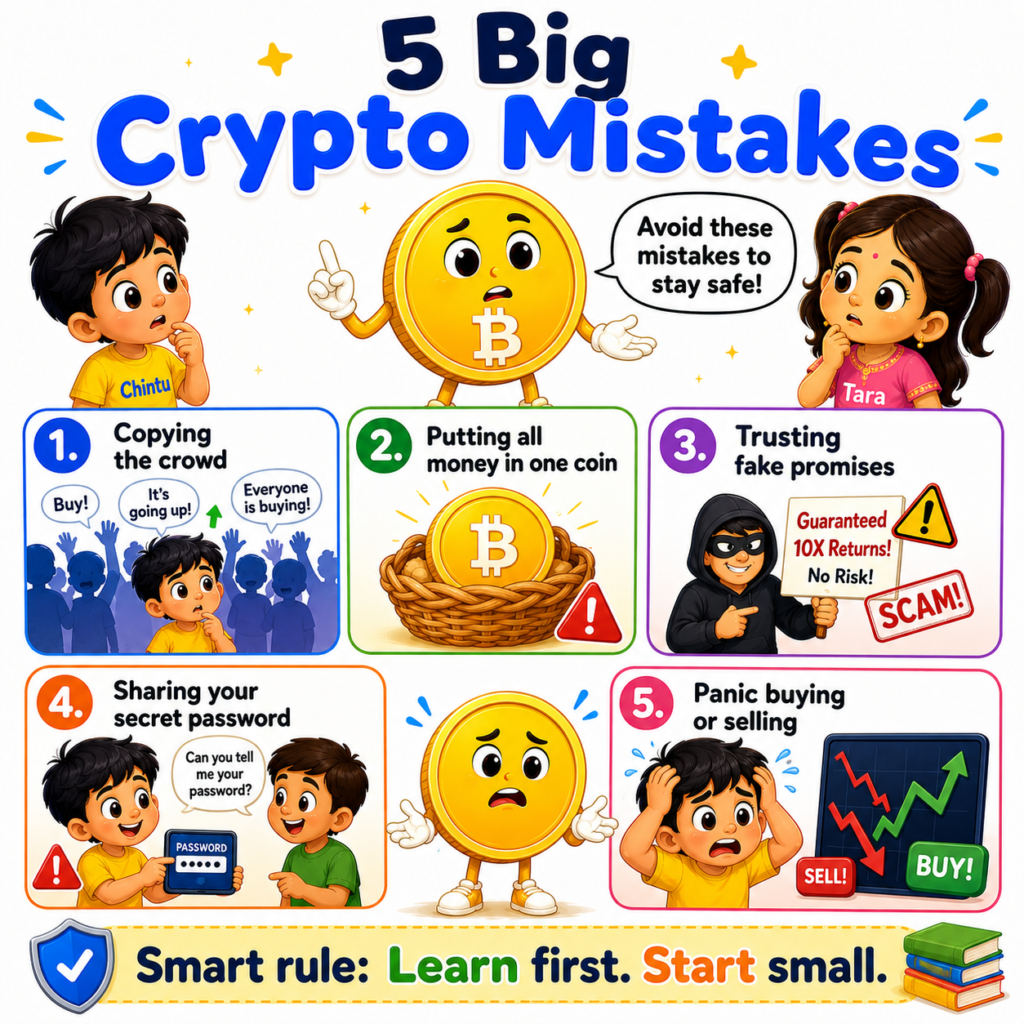
Biggest Mistakes Beginners Make in Crypto
1. The first mistake is entering crypto only for quick money.
2. The second mistake is taking tips from random Telegram groups.
3. The third mistake is investing money needed for rent, EMI, or family expenses.
4. The fourth mistake is buying a coin after it has already pumped heavily.
5. The fifth mistake is not booking profit because of greed.
6. The sixth mistake is panic selling during every fall.
7. The seventh mistake is not understanding taxes.
Crypto is not a casino if you treat it like a skill. But if you enter without knowledge, it becomes gambling.
How Should a Beginner Start?
Start with learning, not buying.
First understand what Bitcoin is. Then understand Ethereum. Then learn about stablecoins, exchanges, wallets, taxes, and risk management.
After that, observe the market.
See how prices move. See how news affects crypto. See how people behave when prices rise and fall.
Then, only if you are comfortable, start with a small amount.
A good beginner rule is:
Never invest money that can disturb your home, family, rent, EMI, or peace of mind.
Simple Beginner Strategy
Here is a simple and safer approach for beginners:
Learn for 10 to 15 days before buying anything.
Start with popular cryptocurrencies instead of unknown coins.
Avoid coins promoted with “100x guaranteed” language.
Use only trusted exchanges.
Keep your account secure with strong passwords and 2FA.
Do not take loans for crypto.
Do not trade when emotional.
Keep records for taxes.
Book profits slowly instead of waiting for impossible targets.
Accept that loss is part of the game.
Crypto Is an Opportunity, Not a Lottery
Many Indian men silently carry pressure.
Pressure to earn more.
Pressure to support parents.
Pressure to build a house.
Pressure to get married.
Pressure to give family a better lifestyle.
Pressure to not fall behind.
So when crypto looks like a way to make fast money, it feels attractive.
But remember this:
You do not need one lucky trade. You need financial discipline.
Crypto can be one part of your financial journey. It can teach you about money, technology, markets, patience, and risk. But it should not become an addiction.
The goal is not to become rich by tomorrow morning.
The goal is to become smarter with money every month.
Final Words: What Is Cryptocurrency in One Line?
Cryptocurrency is digital money powered by blockchain technology that allows people to store, send, and trade value on the internet.
It is exciting.
It is risky.
It is powerful.
It is not easy money.
For beginners, the best path is simple:
Learn first. Start small. Stay patient. Protect your money. Respect risk.
If you understand crypto properly, you will not enter the market like a gambler. You will enter like a student. And in any market, the serious student always has a better chance than the impatient gambler.
FAQs About Cryptocurrency
What is cryptocurrency in simple words?
Cryptocurrency is digital money that exists online and uses blockchain technology to record transactions securely.
Is crypto safe for beginners?
Crypto can be risky for beginners because prices move very fast. Beginners should learn first, start small, and never invest money they cannot afford to lose.
Can I become rich from cryptocurrency?
Some people have made huge money from crypto, but many people have also lost money. Crypto should be treated as a high-risk asset, not a guaranteed income source.
Which crypto should beginners learn about first?
Beginners should first learn about Bitcoin and Ethereum because they are the most established and widely discussed cryptocurrencies.
Is crypto taxable in India?
Yes. In India, income from virtual digital assets is generally taxed at 30%, and 1% TDS may apply on certain transactions. (cleartax)
Should I trade crypto daily?
Most beginners should avoid daily trading at the start. Daily trading requires skill, emotional control, chart knowledge, and risk management. Start by learning and observing first.